
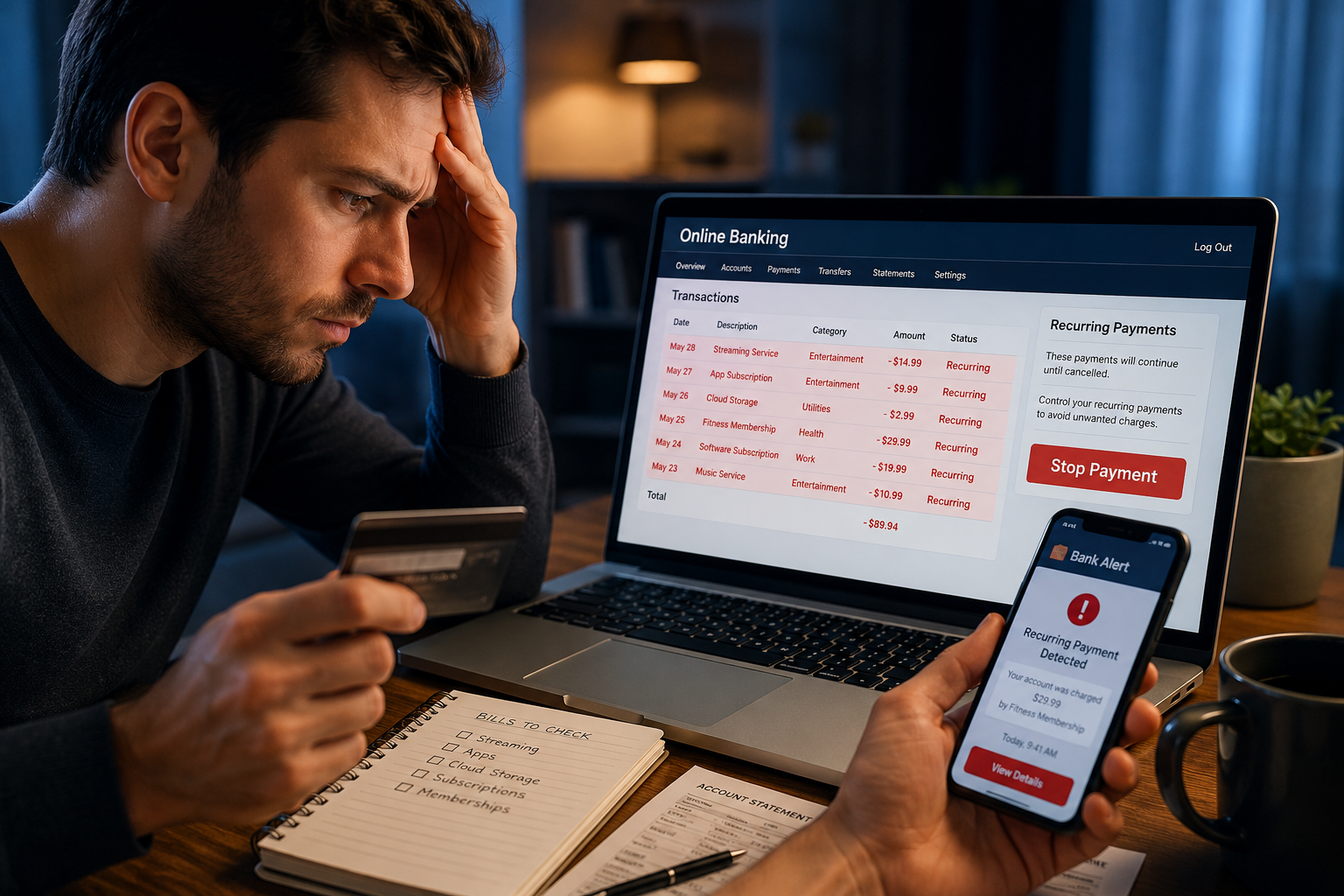
Two switches may need to be turned off
People often say "stop the payment" when they mean two different things: end the service, and withdraw permission to take money from the account. Doing only one can leave a loose end.
For example, telling the bank to block a debit may not cancel a gym contract or loan. Canceling a membership may not stop a debit immediately if the company mishandles the request. Treat the contract and the payment authorization as separate, then document both.
This guide is general information. Bank procedures and legal rights vary by country, account type, and payment rail.
Identify the payment type first
Open a completed transaction and ask the bank how it was processed. The right procedure can differ for:
- An automatic debit using your account and routing details.
- A recurring debit-card or credit-card charge.
- A standing order or bill payment that you scheduled through the bank.
- An app-store, PayPal, or digital-wallet authorization.
Do not rely on the merchant name alone. Ask the bank to identify the payment rail if it is unclear.
The clean sequence
1. Tell the company to stop
Use the company's official cancellation method. State whether you are ending the contract, withdrawing authorization for future automatic payments, or both. Ask for the effective date in writing.
Keep the message simple: identify the account, name the payment, state what should stop, and request confirmation. Do not include bank passwords or full account numbers in ordinary email.
2. Follow up in writing
If you canceled by phone, send a short email or secure message the same day. Include the date, time, representative name or case number, and what was agreed. A written timeline is much more useful than trying to remember a call later.
3. Notify the bank or credit union
Tell the bank that you withdrew authorization from the company and want to stop future automatic payments. Ask which form or written notice it requires and how much lead time is needed before the next scheduled debit.
In the United States, the CFPB says consumers can revoke authorization for automatic debits and may also be advised to use a stop payment order. Fees and procedures can apply, so ask the bank to explain them before you confirm.
4. Ask exactly what will be blocked
Will the instruction block one amount, one merchant, one payment rail, or every future debit from that originator? What happens if the merchant changes the amount or descriptor? Get the answer in writing when possible.
5. Monitor the next billing date
Do not assume the job is finished when you receive a case number. Check the account shortly before and after the next expected debit. Keep enough money in the account for other obligations and consider account alerts.
A message for the company
Please cancel [service or contract, if applicable] and withdraw my authorization for future automatic payments from [masked payment method]. The next payment is expected on [date]. Please confirm the effective date and that no further automatic payment will be initiated.
A message for the bank
I withdrew authorization from [company] on [date] for the recurring payment shown as [exact descriptor]. The next payment is expected on [date]. Please tell me the required procedure to stop future payments, any deadline or fee, and how this instruction will be recorded.
Use the bank's secure message center or official form rather than ordinary email if account details are required.
If another payment goes through
Contact the bank promptly. Provide the earlier notice, cancellation confirmation, descriptor, amount, and date. Ask whether the transaction is treated as unauthorized after revocation and what dispute deadline applies.
Also send the company a factual note referencing the prior cancellation. Avoid filing conflicting claims with both parties; keep the dates and explanation consistent.
Things that do not reliably solve the problem
- Deleting an app: billing can continue through the app store or merchant account.
- Replacing the card: some recurring merchants receive updated card details through network services.
- Closing the account immediately: this can disrupt legitimate payments and does not erase money you still owe.
- Blocking payment on a loan: stopping automatic debit does not cancel the repayment obligation.
- Waiting until the night before: banks and merchants may have processing cutoffs.
The proof worth keeping
- Contract or subscription terms.
- The original payment authorization, if available.
- Cancellation and revocation notices.
- Bank forms, secure messages, and case numbers.
- Statements showing the last authorized and any later payment.
- Notes of calls, including date, time, and outcome.
The practical finish line
You are done when the service or contract status is clear, the payment authorization is dealt with, the bank has recorded any necessary instruction, and the next billing date passes without an unexplained debit. Until then, keep the evidence and monitor the account.
Comments (0)
No published comments yet. Start a useful, respectful discussion.