
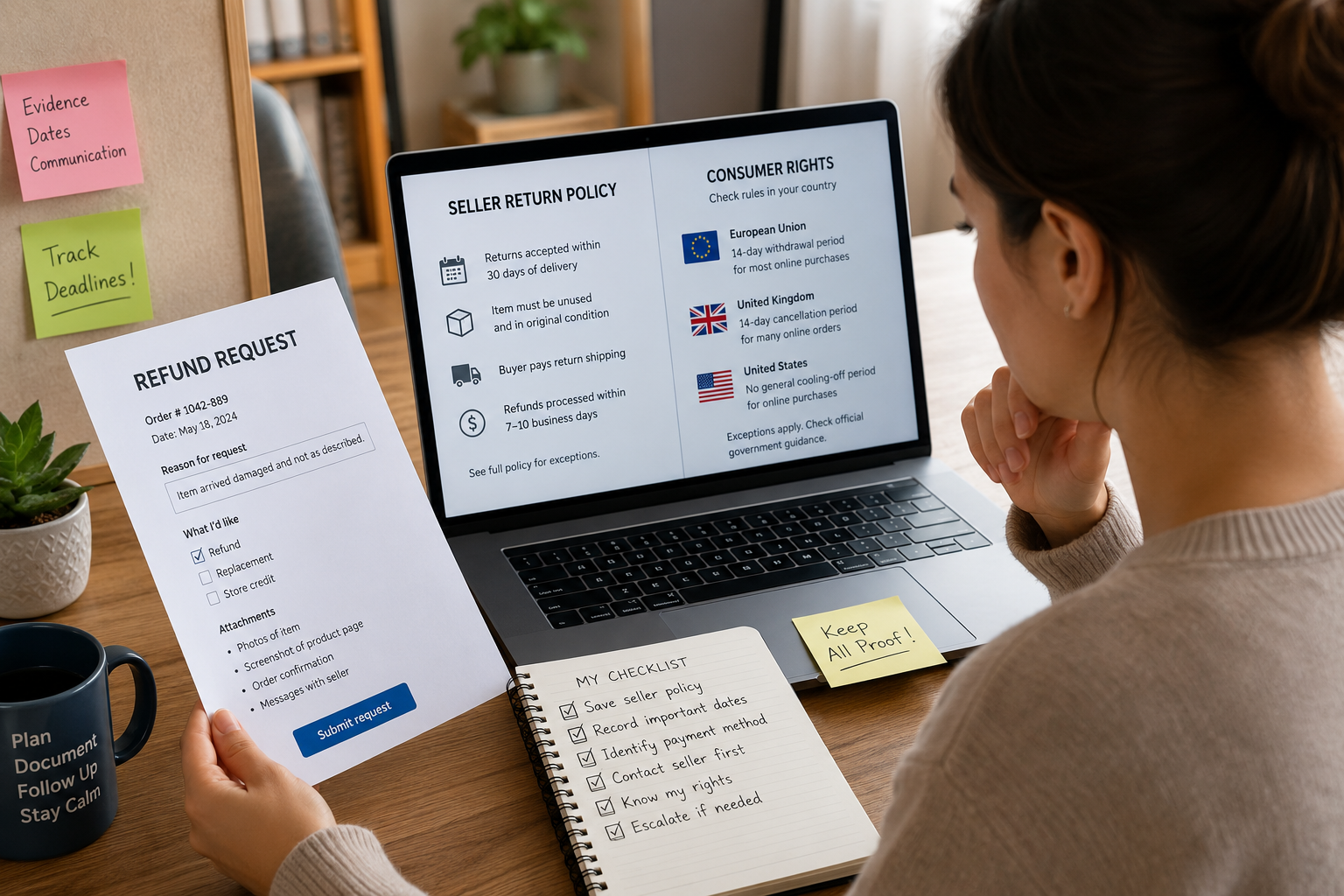
A refund policy is not the whole answer
You ask a company for your money back. Support replies with one short sentence:
“This purchase is non-refundable.”
That answer can feel final, but it does not always tell you the complete story.
A company’s refund policy explains what the company normally chooses to offer. Consumer law can create additional rights that the company must respect, depending on where you live and what happened.
The correct answer can change based on:
- Your country or region
- The seller’s location
- Whether you bought online or inside a store
- The type of product or service
- Whether a digital product was accessed
- Whether an order arrived late, damaged or not at all
- How quickly you cancelled or complained
- Whether you paid the seller, a marketplace or a payment provider
This guide will not tell you that every purchase is refundable. It will help you identify which rules and evidence apply before you accept a rejection or start a payment dispute.
Fast answer
Before requesting a refund, identify these five facts:
- Where you live
- What you purchased
- When you purchased, received or activated it
- Who processed the payment
- Why you want the money back
Then compare three things:
- The seller’s published refund policy
- The official consumer rules for your location
- The refund or dispute rules of the company that processed your payment
Do not rely only on a support agent’s message, an online comment or a refund guide written for another country.
Why your country can change the outcome
Consumer protection is not identical worldwide.
A person buying a product online in the European Union can have rights that do not apply in exactly the same way to a customer in the United States. A customer in the United Kingdom may have a legal cancellation period for an online order, while a customer elsewhere may depend more heavily on the seller’s policy or local contract law.
Even countries with similar rules can have different:
- Cancellation periods
- Return deadlines
- Product exclusions
- Digital-content rules
- Seller disclosure requirements
- Refund-processing deadlines
- Complaint procedures
- Card-dispute protections
That is why a statement such as “you always have fourteen days” is unsafe without first identifying the country, purchase type and applicable exception.
A real difference between regions
European Union online purchases
Official European Union guidance states that consumers generally have a fourteen-day withdrawal period for many products and services purchased online, by telephone or away from a seller’s normal business premises.
For goods, the period generally begins when the goods are delivered. For services, it generally begins when the contract is concluded.
The right has exceptions. These include certain:
- Hotel bookings and transport tickets for specific dates
- Event tickets
- Perishable products
- Personalised or custom-made goods
- Unsealed software and media
- Fully delivered services started with the customer’s agreement
- Digital content where access began after the customer expressly agreed to lose the withdrawal right
This means that an online physical product and an immediately accessed digital download cannot automatically be treated in the same way.
Official reference: European Union returns and withdrawal rights
United Kingdom online purchases
United Kingdom government guidance states that customers who buy online, by mail or by telephone generally have a limited right to cancel even when the item is not faulty.
For many qualifying purchases, the customer must tell the seller within fourteen days of receiving the item. The customer then generally has another fourteen days to return it.
Exceptions can include:
- Personalised products
- Perishable goods
- Unwrapped software or media
- Opened sealed hygiene products
- Certain date-specific services
A damaged, faulty or misdescribed product is also different from a simple change-of-mind return.
Official reference: United Kingdom returns and refunds guidance
United States online purchases
The United States does not have one universal federal rule giving customers three days to cancel every online purchase.
The Federal Trade Commission’s Cooling-Off Rule covers certain sales made at a customer’s home, workplace or a seller’s temporary location. The rule generally does not cover purchases completed entirely online, by mail or by telephone.
However, federal rules do address shipping promises. The Federal Trade Commission states that sellers must ship within the time they promised. When no shipping time is stated, the seller generally must ship within thirty days after receiving the required order and payment information.
When a seller cannot ship on time, it must notify the customer and provide the option to accept the delay or cancel for a full refund.
Official references:
The reason for the refund matters
A request based on changing your mind is not the same as a request involving a serious problem.
Separate your situation into one of these categories.
You changed your mind
The product arrived correctly, works properly and matches its description, but you no longer want it.
Your rights can depend heavily on:
- Whether the purchase was online or in-store
- Your location
- The seller’s voluntary return policy
- Whether you opened or used the product
- Whether the product falls under an exception
In-store change-of-mind purchases often receive different treatment from online purchases.
The product is faulty
The product does not work properly, is unsafe, broke unexpectedly or cannot perform its intended purpose.
Do not describe this only as “I changed my mind.” State the specific defect and when you discovered it.
Save photographs, videos, error messages, repair assessments and communications with the seller.
The item was not as described
The product is materially different from the listing, advertisement or order confirmation.
Save:
- The original listing
- Product photographs
- Advertised measurements or features
- Order confirmation
- Images of what arrived
- Messages from the seller
Do not rely on the seller’s current listing. Product pages can be edited after purchase.
The order never arrived
Save the promised delivery date, tracking information and every delivery update.
Check whether the seller, courier or marketplace is responsible for handling the first complaint.
In the United States, Federal Trade Commission guidance states that sellers must ship as promised and must offer cancellation and a full refund when they cannot complete the shipment under the applicable rule.
Official reference: Federal Trade Commission guidance for undelivered orders
The order arrived late
A late order can matter when delivery by a specific date was essential and communicated before purchase.
Examples include an item purchased for a scheduled event or a service booked for a fixed date.
Save proof showing:
- The promised delivery date
- Why that date mattered
- The actual delivery date
- Messages sent before the deadline
- The seller’s response
The charge was unauthorized
An unauthorized transaction is different from an unwanted renewal or a purchase you later regretted.
Use the term unauthorized only when you, and anyone permitted to use the account or payment method, did not approve the transaction.
When you personally started a trial and forgot to cancel, describe it as an unintended renewal rather than card fraud.
Product type changes the rules
Before reading any refund policy, identify exactly what you bought.
Physical products
For physical goods, record:
- Purchase date
- Delivery date
- Product condition
- Whether packaging was opened
- Whether the item was used
- Whether it is faulty or misdescribed
- Return-request date
- Return tracking number
When returning an item, use tracked shipping when practical and retain the receipt.
A seller may say it never received the return. Tracking evidence can become the most important part of your case.
Digital downloads
Downloading, streaming or activating digital content can affect cancellation rights.
In the European Union, the withdrawal right can be lost for online digital content when performance begins after the consumer expressly agrees to immediate access and acknowledges losing that right.
Save the checkout screen showing:
- What you purchased
- When access would begin
- Any consent checkbox
- Any statement about cancellation rights
- The confirmation email
Software and applications
Software can be billed through:
- The software company
- Apple
- Google Play
- Microsoft
- A marketplace
- A reseller
The company whose product you used is not always the company that processed the payment.
Check the receipt before sending the refund request.
Subscriptions
For a subscription, determine:
- Whether it began with a free trial
- The renewal date
- Whether the plan was monthly or annual
- When cancellation was completed
- Whether you received a confirmation
- Whether you continued using paid features
- Who processed the payment
Cancelling normally prevents a future renewal. It does not automatically create a refund for a charge that has already been completed.
Hotel and travel bookings
Accommodation, transportation and date-specific reservations often follow special terms and can fall outside general change-of-mind withdrawal rules.
Check:
- Cancellation deadline
- Refundable or non-refundable rate
- No-show terms
- Date-change rules
- Provider cancellation
- Travel-platform protection
- Applicable local travel rules
Event tickets
Date-specific event tickets can be excluded from general cooling-off protections.
However, a cancelled, postponed or materially changed event can create a different refund question.
Save the original event description, scheduled date and any cancellation or postponement notice.
Custom-made products
Personalised and made-to-order items are commonly excluded from ordinary change-of-mind cancellation rights.
That does not mean a seller can ignore a product that is faulty, damaged or different from the agreed specification.
Professional services
For a service, record:
- What work was promised
- Completion date
- Written estimate
- Contract terms
- Work actually completed
- Defects or missing work
- Opportunity provided to correct the problem
Do not treat a partly completed service exactly like an unopened physical product.
Step-by-step process before asking for money back
Step one: Identify your legal location
Write down:
- Your country of residence
- The country where the order was delivered
- The seller’s stated business location
- The marketplace or platform used
A seller’s website language or currency does not prove where the business is legally established.
Check the company’s terms, legal notice, invoice or business-information page.
Step two: Define the exact problem
Use one clear sentence.
Examples:
- “The product arrived damaged.”
- “The seller did not deliver the order.”
- “The item is different from the listing.”
- “The subscription renewed after I cancelled.”
- “I changed my mind after an online purchase.”
- “The service was not completed as agreed.”
Avoid writing only “I want a refund.” The reason determines which rule and evidence matter.
Step three: Build a timeline
Write the important dates in order:
- Purchase date
- Payment date
- Promised delivery date
- Actual delivery date
- Activation or download date
- Cancellation date
- Date the problem was discovered
- First contact with the seller
- Seller response date
- Return date
- Refund-request date
Use the dates shown in receipts, emails and account records. Do not depend on memory when written evidence is available.
Step four: Save the policy and official rule
Save a screenshot or copy of:
- Product listing
- Seller refund policy
- Cancellation terms
- Delivery promise
- Checkout page
- Order confirmation
- Official consumer guidance for your country
Include the date and page address when possible.
A seller can update its website. Your saved copy shows what was presented when you acted.
Step five: Identify the payment channel
Check whether the payment was processed by:
- The seller
- A marketplace
- Apple
- Google Play
- PayPal
- A credit card
- A debit card
- A digital wallet
- A buy-now-pay-later provider
- Another payment service
Your receipt normally identifies the correct route.
Do not open disputes with several providers at the same time without understanding their rules. Duplicate claims can complicate the case.
Step six: Contact the seller through the official route
Start with the seller when the seller is reachable and the transaction is not clearly fraudulent.
Use the official:
- Refund form
- Return portal
- Billing-support page
- Customer-service email
- Marketplace-resolution centre
Avoid unofficial telephone numbers found in advertisements or random search results.
Refund request example
Hello,I am requesting a refund for [product or service], purchased on [date] under order number [order number].The issue is [clear factual description]. I contacted you on [date] and have attached the receipt and relevant evidence.I am requesting [a refund, replacement, repair or cancellation]. Please confirm the next steps and provide the decision in writing.Thank you.
Keep the message factual. Do not threaten the company or accuse it of fraud unless you have evidence of fraud.
Step seven: Read the denial carefully
A denial may say:
- The request was submitted too late
- The product is excluded
- The item was used or damaged
- Digital access already began
- The wrong company was contacted
- The seller needs additional evidence
- The transaction was processed by another provider
- The product must be returned first
- The seller cannot locate the transaction
Do not reply only with “this is unfair.”
Compare the stated reason with:
- The policy shown at purchase
- Official local consumer guidance
- Your payment-provider rules
- Your saved timeline
- Your evidence
Step eight: Escalate through the correct channel
When the seller does not resolve the problem, the next route can include:
- Marketplace buyer protection
- Payment-provider complaint
- Card issuer dispute
- Local consumer authority
- Alternative dispute resolution
- Small-claims or court procedures where appropriate
Each route has deadlines and evidence requirements.
A chargeback is not a replacement for every refund request. It is a formal payment dispute and should be based on an accurate reason.
Proof checklist
Before submitting or escalating a refund request, collect:
- Receipt or invoice
- Order number
- Payment confirmation
- Product listing
- Seller identity and contact details
- Refund policy shown at purchase
- Cancellation policy
- Promised delivery date
- Tracking information
- Photographs or videos of the problem
- Cancellation confirmation
- Return-shipping receipt
- Return tracking
- Support messages
- Refund-denial message
- Payment-provider case number
- A written timeline
Hide passwords, complete card numbers, security codes and unrelated financial information before sending screenshots.
A personal example: the same purchase, different questions
Imagine that you order a pair of headphones online and later decide you do not want them.
The first question is not simply:
“Can I get a refund?”
The useful questions are:
- Which country’s consumer rules apply?
- Was the seller a business or private individual?
- Were the headphones purchased online or inside a store?
- Have they been opened or used?
- Does a hygiene-related exclusion apply?
- When were they delivered?
- When did you notify the seller?
- Who pays return shipping?
- What did the seller disclose before purchase?
Now change one fact: the headphones arrived broken.
The case is no longer only about changing your mind. It is now about faulty goods, which can create different rights and remedies.
Now change another fact: the parcel never arrived.
The focus becomes delivery proof, shipping promises and non-delivery procedures.
One product can create several completely different refund cases depending on what happened.
Common mistakes that weaken a refund request
Assuming every country has a fourteen-day rule
Fourteen-day withdrawal periods exist in the European Union and United Kingdom for many qualifying distance purchases, but they are not a universal global rule.
Check the rule for your location.
Confusing store policy with legal rights
A store may voluntarily offer a generous return policy.
It may also publish a strict policy that does not remove mandatory rights granted by applicable local law.
Review both the policy and the official consumer source.
Using the wrong refund reason
Do not describe a faulty item as a change-of-mind return.
Do not describe an accidental renewal you authorised as card fraud.
Use the most accurate reason and support it with evidence.
Missing the deadline while arguing with support
Refund, return and payment-dispute deadlines can continue running while you exchange messages with a seller.
Record every deadline and act through the official route before it expires.
Returning an item without tracking
Without a receipt or tracking record, you may be unable to prove that the item was returned.
Keep proof until the refund is complete.
Contacting the product company instead of the billing provider
An application can be billed through Apple or Google Play. A marketplace seller can be paid through the marketplace.
The receipt identifies who processed the payment.
Deleting the account too early
An account can contain invoices, subscription details, support messages and cancellation evidence.
Save everything and resolve the billing issue before deleting it.
Sending private banking information
A seller may need the transaction date, amount, reference and limited payment details.
It does not need your password, security code or complete online-banking history.
What not to assume
Do not assume:
- Every country gives the same return period
- Every online purchase can be cancelled
- Every digital purchase is non-refundable
- A seller’s policy is the only rule
- A marketplace and seller have identical obligations
- Cancelling a subscription automatically refunds it
- Deleting an application cancels billing
- A pending charge is already a completed payment
- A card dispute can be filed at any time
- A refund is complete because support says it was issued
Check the source that applies to your location, purchase and payment method.
Frequently asked questions
Does every country give customers fourteen days to cancel?
No.
The European Union and United Kingdom provide fourteen-day cancellation rights for many qualifying distance purchases, subject to exceptions. This is not a universal worldwide rule.
Does a company’s “no refunds” policy remove my legal rights?
Not where applicable local law gives you mandatory consumer rights.
However, the existence and scope of those rights depend on the country, purchase type and circumstances.
Is an online purchase always easier to return?
No.
Online purchases can receive special distance-selling protections in some regions, but exclusions can apply to digital content, personalised items, perishable goods, hygiene products, date-specific bookings and other categories.
Can I return a product simply because I changed my mind?
That depends on where and how you purchased it.
An online change-of-mind purchase can be treated differently from an in-store purchase. The seller’s voluntary policy may also provide additional options.
What if the item is faulty?
State the defect clearly and save evidence.
Faulty-product rights can differ from change-of-mind return rights. The available remedy can include repair, replacement, price reduction or refund depending on the applicable rules and circumstances.
What if my order never arrived?
Contact the seller through its official non-delivery process and save the promised delivery date and tracking information.
When the seller does not resolve the case, check marketplace protection and the dispute rules for your payment method.
Can downloaded digital content be refunded?
It depends on the applicable law, seller terms and whether access or performance began.
In the European Union, starting a digital download or stream after expressly agreeing to immediate performance and acknowledging the loss of withdrawal rights can remove the ordinary withdrawal right.
Does cancelling a subscription create a refund?
No.
Cancellation normally stops future renewal. A completed charge usually requires a separate refund request.
Should I contact the seller or my bank first?
For a recognised transaction and ordinary refund problem, begin with the seller or payment platform when it is reachable.
Contact the bank promptly when the charge is genuinely unauthorized, the card may be compromised, or the seller cannot resolve a valid payment dispute.
What if the seller is in another country?
Check:
- Your local consumer guidance
- The seller’s legal location
- The law identified in the terms
- Marketplace protections
- Payment-provider dispute options
- Cross-border consumer assistance available in your region
Cross-border cases can involve more than one set of rules.
How long should I keep my evidence?
Keep the records until the refund has reached your payment account and any dispute or appeal period has ended.
A refund confirmation alone does not prove that the money has arrived.
Final advice
A refund denial can make you feel as though you have no options. Do not panic, and do not begin by sending angry messages to every company connected to the payment.
Follow the facts:
- Identify the country and purchase type.
- Write down the dates.
- Save the policy and official local rule.
- Identify who processed the payment.
- Contact the correct official route.
- Keep every piece of evidence.
- Compare any denial with the rule that actually applies.
- Escalate before the relevant deadline expires.
The goal is not to claim rights you do not have. The goal is to avoid losing valid rights because you followed advice written for the wrong country, product or payment method.
This guide provides general consumer information. It is not legal advice. Consumer rights and dispute procedures depend on your location, transaction and individual circumstances.
Related guides
- Refund after a subscription renewal
- Chargeback vs refund
- Return window calculator