
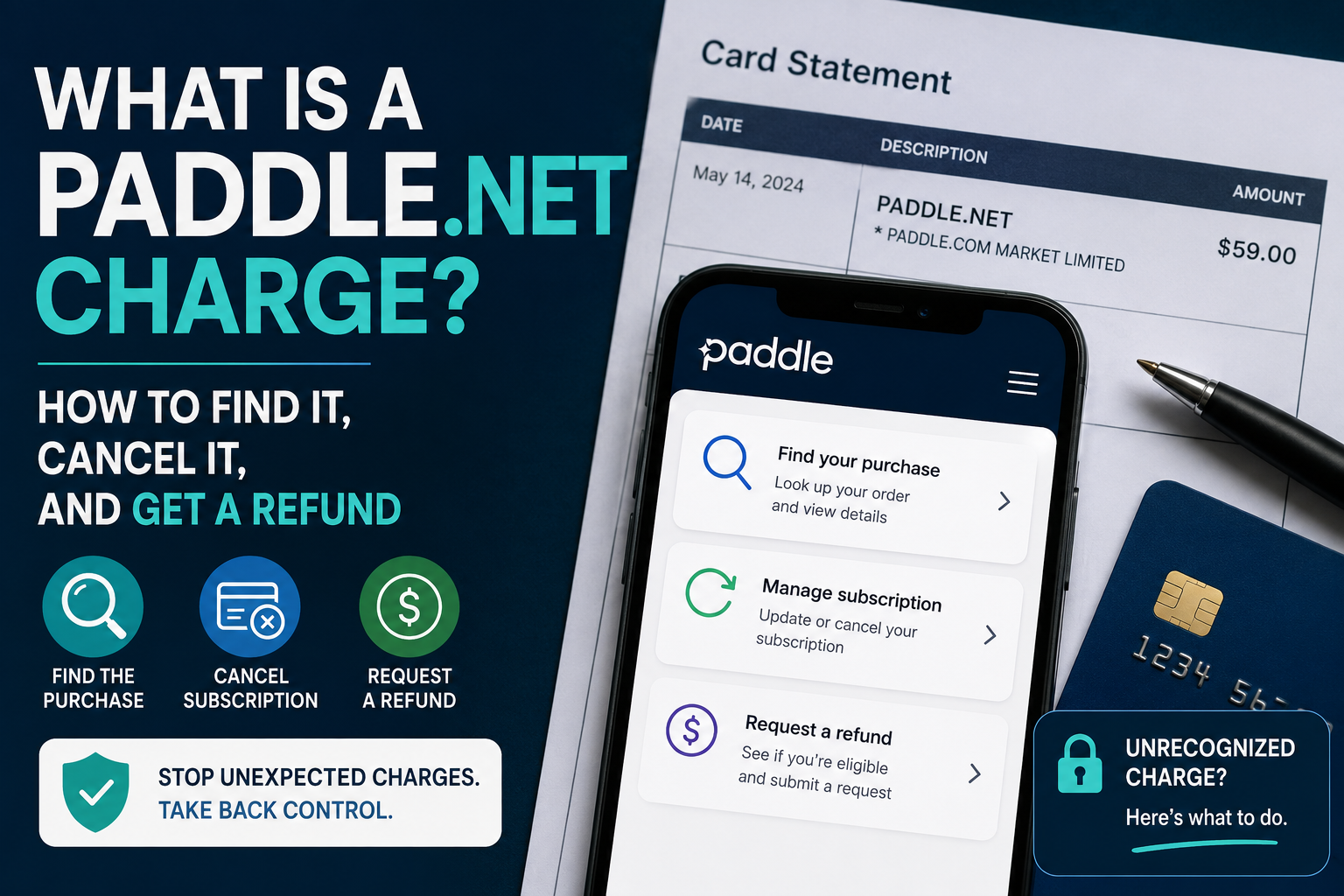
Why the name looks unfamiliar
Paddle is a merchant of record for thousands of software businesses. In plain language, it can handle the checkout, payment, tax, and billing paperwork for the software company. That is why your statement may say Paddle or Paddle.net even though the product has a completely different name.
The descriptor is a clue, not proof that the payment is wrong. Your first job is to connect it to a receipt, product, and account.
Find the product behind the charge
Search the inbox used at checkout
Search for "Paddle," the exact amount, and the charge date. Look for a receipt, invoice, trial reminder, or subscription email. Check spam and any older email address you use for software.
The bank's posting date can be later than the purchase date, so search several days either side. A receipt link may open the matching transaction directly in Paddle buyer support.
Use Paddle's official buyer support
Go directly to paddle.net or follow the buyer-support link from Paddle's official site. Paddle says its support flow can look up transaction details and may allow you to cancel a subscription or request a refund.
Avoid phone numbers or "charge lookup" pages from random search results. Use Paddle's own domain and do not provide a password, one-time code, or full card number to an unofficial site.
Check for more than one subscription
If you canceled something but a Paddle charge returned, do not assume the cancellation failed. You may have a second subscription, a one-time software purchase, or another account using the same card. Match the amount and receipt before opening a dispute.
Cancel a Paddle-billed subscription
Open Paddle buyer support with the receipt or transaction details and locate the subscription. Follow the cancellation flow and save the effective end date.
Also check the software company's account. Paddle may manage the payment while the supplier manages access, plan changes, or parts of support. If one screen says canceled and another says active, contact the supplier and Paddle with the same transaction ID.
Cancellation normally stops a future renewal. It does not automatically refund a completed payment, so verify those outcomes separately.
Ask for a refund without overpromising the result
Paddle's official guidance says eligible buyers can request a refund through its virtual assistant. In some cases, the software supplier's policy affects the decision. Timing, local consumer rights, product use, and the reason for the request may matter.
Include:
- Transaction or receipt number.
- Product name and account email.
- Charge date, amount, and currency.
- Cancellation date, if already canceled.
- A brief factual reason for the request.
Ask for the decision and expected processing time in writing. If the seller's policy is being applied, ask for the relevant policy page.
If you still do not recognize it
Check household members, work purchases, old email accounts, and password-manager entries. If nobody recognizes the purchase, contact Paddle through its official support and ask it to identify the transaction.
If it remains unknown or is clearly unauthorized, contact the bank or card issuer promptly. Ask about securing the card and the dispute deadline. Do not delay urgent card protection while waiting for a merchant answer.
A simple decision path
- Receipt found and purchase recognized: cancel future billing if needed, then request a refund under the applicable policy.
- Paddle found the product but the amount looks wrong: ask for the invoice and an explanation of tax, currency, plan, or duplicate billing.
- Canceled but charged again: compare transaction IDs and check for a second subscription before escalating.
- No one recognizes the payment: protect the card, contact Paddle, and speak with the issuer about an unauthorized-charge review.
Save these four things
Keep the receipt, the exact statement descriptor, the cancellation confirmation, and the support case number. Those four items create a clear timeline for Paddle, the software supplier, or your bank if the first request does not resolve the issue.
Comments (0)
No published comments yet. Start a useful, respectful discussion.